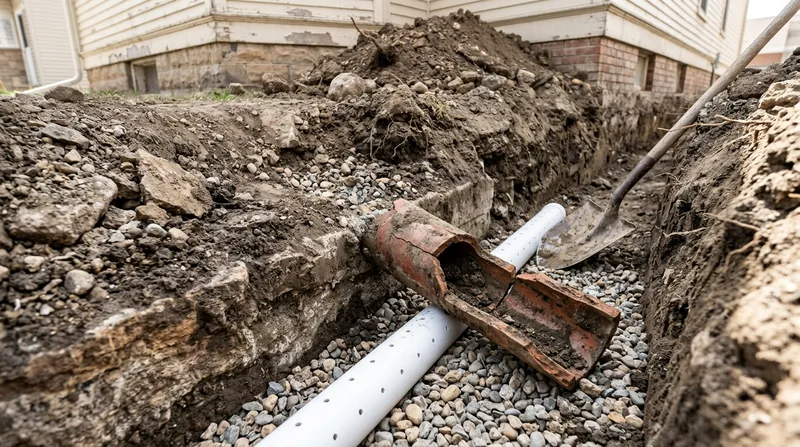




Drain Tile Repair & Replacement in Rapid City: When the Footing Drain Stops Doing Its Job
If you own a home in Rapid City, your foundation sits on ground that moves. The Black Hills meet the plains here along Rapid Creek, and much of the city rests on expansive bentonite clay over Pierre Shale. That clay swells when wet and shrinks when dry, and it pushes hard against foundation walls. Drain Tile Repair & Replacement in Rapid City is the work that restores the one system meant to carry that water away before it reaches the wall.
Many homes in North Rapid and near downtown were built between 1910 and 1950 with clay tile footing drains. Those tiles crack, fill with silt, and get invaded by cottonwood and bur oak roots. Once the run is blocked, snowmelt and summer cloudburst water has nowhere to go but down along the footing and into the basement. We camera the line, find the break, and replace it with modern PVC. Start with a free basement inspection so we can see what the drain is actually doing.
Why Drain Tile Fails So Often in Rapid City's Black Hills Soil
The failure mode that dominates here is not a single dramatic event. It is the freeze-thaw cycle working on old clay tile season after season, combined with bentonite clay that heaves slabs and shifts walls as it takes on water. Add steep pine-covered foothill lots on Sheridan Lake Road and in the Red Rocks area, where snowmelt runs downhill toward uphill walls, and the footing drain carries a load it was never sized for.
- Original clay tile from the 1910s through the 1950s cracks at the joints and lets silt in until the run is effectively solid.
- Cottonwood and bur oak roots find the moisture in the line and clog it within a few growing seasons.
- Bentonite clay movement shears the tile run and opens gaps right where the water needs to keep moving.
- Hillside homes in Black Hawk and Summerset send concentrated snowmelt into drains that were laid for a flatter lot.
- Homes in the Rapid Creek floodplain carry a water table that rises fast after a spring melt or a hard summer storm.
When that water backs up against the footing, you get efflorescence on the wall, a musty smell, and eventually a wet basement after every rain.
Key info: A 1920s bungalow off West Boulevard can have a drain that has been dead for thirty years and nobody knew, because the water only shows up in a wet spring. Camera inspection tells you the truth before you spend money on the wrong fix.
Permits for work that alters drainage or the sanitary connection of a sump discharge vary by jurisdiction, so confirm the requirements with the City of Rapid City building department before any excavation begins.
How We Diagnose and Replace a Failed Drain Tile Run in Rapid City
We do not start digging on a guess. The first step is a camera inspection of the existing line, run from a cleanout or from the sump basin, so we can see the break, the root mass, or the collapsed section. From there we map the run, check the grading and downspout extensions, and decide whether a targeted repair or a full replacement is the honest answer.
- We camera the existing footing drain and mark the failure points on a sketch of the foundation.
- We check the sump basin, the check valve, and the discharge line for a second problem hiding behind the first.
- We excavate only the section that failed when a targeted repair will hold, and we replace the full run when the tile is silted solid.
- We lay new perforated PVC in a washed gravel bed with the correct fall toward the sump, then backfill and compact in lifts.
- We restore grading and downspout extensions so surface water stops loading the drain from above.
On a Robbinsdale split-level, we found a 1960s clay run that had collapsed under a patio slab and was sending water straight to the lower-level wall. A targeted replacement under the slab, tied into the existing sump basin, dried the wall without touching the rest of the yard.
Key info: If the camera shows a run that is intact but the wall is still wet, the problem may be hydrostatic pressure rather than a broken tile. In that case an interior drain tile system is often the better answer than exterior excavation, and we will tell you so.
Repair Methods We Use on Rapid City Drain Tile
Not every failed drain needs the same treatment. The method follows the diagnosis, the depth of the footing, and how much of the run is actually compromised. Here is how the options compare on Black Hills soils.
| Approach | Description | Best for |
|---|---|---|
| Targeted spot repair | Excavate and replace one failed section, tie into sound tile on both sides. | A single collapsed joint or root intrusion on an otherwise open run. |
| Full footing drain replacement | Remove the old clay tile and lay new perforated PVC in gravel with correct fall. | Silted or sheared tile from the 1910s to 1950s that no longer flows. |
| Interior perimeter drain | Cut a channel at the interior footing and lead water to the sump basin. | Hydrostatic pressure with an exterior drain that cannot be reached or replaced. |
| Drain tie-in to sump | Connect the repaired run to the sump basin with a check valve on the discharge. | Homes that already have a sump pit but no working drain feeding it. |
| Surface water correction | Regrade the soil and extend downspouts away from the wall. | Foothill lots where snowmelt loads the drain from above. |
We recommend the smallest intervention that actually solves the problem, and we say so when simple crack sealing is enough.
Drain Tile Repair & Replacement Cost in Rapid City: What to Expect
Pricing on drain tile work starts from $750 for a targeted repair on an accessible run. A full footing drain replacement around a Rapid City home typically runs well above that, because the cost is driven by the length of the run, the depth of the footing, and how much concrete or landscaping has to come out to reach it.
The factors that move the number are consistent. Access is the biggest one: a run under a finished patio or a mature cottonwood root mass costs more to reach than an open side yard. Depth of footing on a hillside home in Black Hawk or Summerset adds excavation time. A collapsed clay run that has to come out entirely costs more than a single spot repair, and a sump tie-in adds a check valve and discharge work.
Get two or three estimates and ask each one whether they cameraed the line before quoting. A quote given without a camera inspection is a guess. Our full pricing overview lays out how we build a number.
Drain Tile Repair & Replacement Near Me: How to Choose a Contractor Near Rapid City
Searching for drain tile repair near me in Rapid City turns up a mix of dedicated waterproofing specialists, general foundation firms, and plumbers. The work below grade is its own trade, and you want someone who does it every week, not occasionally. Here is what to check before you sign anything.
- Confirm the contractor is licensed and insured, and ask for a certificate of insurance before work starts.
- Get two or three written estimates and compare what each one includes, not just the bottom line.
- Ask for references from Rapid City jobs on similar foundation types, sandstone or brick or poured concrete.
- Ask who pulls the permit if the work alters drainage or the sump discharge connection, and verify the rule with the local building department.
- Check whether your neighborhood or HOA has any restriction on excavation or equipment access before the crew arrives.
We are a Basement Health Association member and we carry a transferable warranty on our drain work. Reach out through our contact page to set up a free inspection at (605) 600-7837.
Drain Tile Repair & Replacement in Rapid City: Pricing Guide
| Service | Price | Details |
|---|---|---|
| Targeted drain tile repair | Starting at $750 | Includes camera inspection and replacement of one accessible failed section, with cost rising on deeper footings or tight access. |
| Full footing drain replacement | Starting at $3,200 | Includes removal of failed clay tile and new perforated PVC in gravel, priced by run length and excavation access. |
| Interior perimeter drain tie-in | Starting at $2,400 | Includes channel at the interior footing and connection to the sump basin, with cost rising on larger footprints. |
| Sump tie-in and check valve | Starting at $650 | Includes connecting the repaired run to an existing sump basin and fitting a check valve on the discharge line. |
| Complex or hillside job | On estimate | Steep foothill lots, slab-covered runs, and heavy root masses need an on-site look before a number is given. |
| Estimate | Free | Response within 24h at (605) 600-7837, no obligation to book. |
Indicative pricing, the exact cost depends on square footage, finish, and site access. Free personalized estimate within 24h at (605) 600-7837.


