



Foundation Crack Repair in Rapid City: What Those Hairline Cracks Under the Pines Really Mean
Rapid City sits where the Black Hills meet the plains, and the ground under your home tells that story every spring. Expansive bentonite clay over Pierre Shale swells when it takes on snowmelt, then shrinks hard during dry, sunny winters, and that cycle works on foundation walls year after year. Foundation crack repair in Rapid City starts with understanding which cracks are cosmetic and which ones are the wall telling you something. In the West Boulevard historic district, sandstone and brick foundations from the 1890s to 1920s crack along mortar joints. In North Rapid and downtown, 1920s to 1950s bungalows on full basements seep at the cove joint. Out on the Red Rocks and Sheridan Lake Road slopes, poured walk-out basements crack at the corners where the footing steps down. We inspect the crack, match the method to what caused it, and tell you plainly when sealing is enough. For the bigger picture on how cracks fit into a wet basement, start with our basement waterproofing service.
Why Foundation Cracks Open Up in Rapid City's Clay and Foothill Soils
The dominant failure mode here is not a bad pour. It is movement. Bentonite clay under a Rapid City footing absorbs spring moisture and pushes outward against the wall while the footing itself heaves, and the wall cracks at its weakest point, usually a corner, a form tie, or a cold joint. Add hard freeze-thaw cycles and cloudbursts that dump an inch in an afternoon, and water finds every opening. Cracks that look harmless in July can be wet by the first March thaw.
- Hydrostatic pressure from saturated clay pushes water through hairline cracks and form ties that were dry all winter.
- Freeze-thaw cycles widen existing cracks as water expands in the opening.
- Settling footings on foothill slopes create diagonal cracks that step down from window corners.
- Efflorescence, the white powder on the wall, shows water is moving through the concrete and evaporating.
- Rapid Creek floodplain homes take on water fast when the water table rises after heavy spring runoff.
Each of these points to a different repair, which is why we inspect before we inject anything.
Key info: A Robbinsdale split-level we inspected last April had a vertical crack under the front porch that had been patched twice with hydraulic cement. The patch kept failing because the crack was moving, not because the cement was bad. Polyurethane injection stopped the leak because it flexes with the wall.
For the official word on what work triggers a permit in our area, check the City of Rapid City building services pages, since thresholds vary and should always be verified before work begins.
How We Repair Foundation Cracks in Rapid City, Step by Step
Every crack gets looked at before it gets touched. We map the crack, check for moisture with a meter, look at the wall for bowing or displacement, and check the grading and downspouts outside. If the crack is a straightforward shrinkage or settlement crack with no lateral movement, injection is the right answer. If the wall is bowing or the crack is wide and active, we talk about structural options instead of hiding the problem behind sealer. You can see how this fits with our foundation waterproofing work.
- We inspect the crack and the surrounding wall, inside and out, and note any bowing, efflorescence, or prior patches.
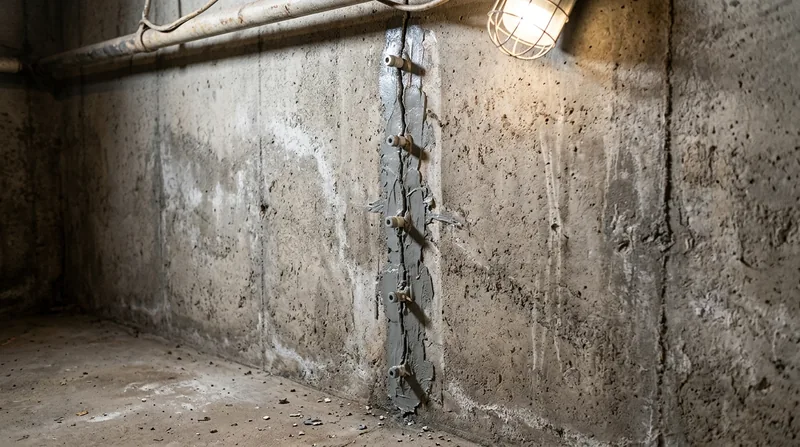
- We clean the crack and set injection ports along its length at the spacing the width requires.
- We seal the surface with an epoxy paste so the injected material stays in the crack and reaches the full depth.
- We inject epoxy for structural, non-moving cracks or polyurethane for active leaks that need to flex with the wall.
- We let the material cure, remove the ports, and grind the surface flush so the wall is ready for finishing.
- We check the repair with a moisture meter and walk you through what we found and what to watch.
That sequence is the same whether the crack is in a 1912 Craftsman off West Boulevard or a 2015 walk-out in the Black Hawk foothills.
Key info: On a Summerset walk-out with a wet corner crack, the real culprit was a downspout discharging two feet from the wall. We injected the crack and extended the discharge line, and the corner stayed dry through the next melt. Sealing alone would have failed by June.
Injection Methods We Match to the Crack
The material matters as much as the technique. Here is how we choose between them on Rapid City foundations.
| Approach | Description | Best for |
|---|---|---|
| Epoxy injection | Structural epoxy bonds the crack faces back together and restores wall strength. | Non-moving shrinkage and settlement cracks in poured walls. |
| Polyurethane injection | Flexible foam expands into the crack and stays watertight as the wall moves. | Active leaks and cracks that move with clay swelling. |
| Crack stitching | Carbon fiber or steel staples bridge the crack and hold it closed. | Wider cracks in block or brick where injection alone won't hold. |
| Cove joint sealing | We fill the wall-to-floor seam where seepage tracks along the footing. | Bungalows and ranches where water enters at the base, not the wall. |
| Drain tile evaluation | We check the footing drain before sealing a crack that keeps leaking. | Cracks that stay wet because hydrostatic pressure has nowhere to go. |
If the crack keeps leaking after injection, the problem is pressure behind the wall, not the injection.
Foundation Crack Repair Cost in Rapid City: What to Expect
Most single-crack injections in Rapid City start at From $450, and that covers a typical vertical crack in a poured wall with standard access. The price moves up with crack length, whether the wall is block or brick, whether the wall is bowing, and how hard it is to reach, like a finished basement corner or a wall behind mechanicals. A crack that turns out to be a symptom of hydrostatic pressure may need more than injection, and we tell you that on the spot rather than selling you a patch that fails.
Get two or three estimates on any crack repair, and ask each contractor what method they plan to use and why. A quote that says "seal the crack" without naming epoxy or polyurethane is not telling you enough. Our full pricing overview breaks down how we scope the work.
Choosing a Foundation Crack Repair Contractor Near Me in Rapid City
A crack repair is only as good as the diagnosis behind it. When you are sorting through contractors near Rapid City, look for a company that inspects before quoting, explains the method, and carries insurance you can verify. Ask whether they pull permits when the scope requires it, since structural foundation repair and drainage changes commonly do, and confirm with the local building department. A written, transferable warranty on the injection work is worth asking about too.
- Confirm the contractor is licensed and insured, and ask for a certificate of insurance before work starts.
- Get two or three written estimates that name the injection method and the crack length covered.
- Ask for local references, ideally from homes of similar age and foundation type to yours.
- Check whether a permit is required for your scope and let the contractor handle it if so.
- Read the warranty terms and confirm they transfer if you sell the home.
If a contractor won't put the method and scope in writing, keep looking. Reach us through our contact page to set up an inspection.
Foundation Crack Repair in Rapid City: Pricing Guide
| Service | Price | Details |
|---|---|---|
| Single vertical crack injection | Starting at $450 | Covers one typical poured-wall crack with ports, epoxy or polyurethane, and surface finishing. |
| Multiple crack package | Starting at $750 | Priced per crack after the first, with the total driven by crack length and wall access. |
| Block or brick wall crack | Starting at $650 | Block and brick take more ports and often stitching, which raises labor and material cost. |
| Crack with active leak or bowing | On estimate | Active leaks and bowing walls need an on-site look to choose between injection and structural repair. |
| Travel | Included | In Rapid City and surrounding areas, no separate call-out or mileage fee. |
| Estimate | Free | Response within 24h at (605) 600-7837, no obligation to book. |
Indicative pricing, the exact cost depends on square footage, finish, and site access. Free personalized estimate within 24h at (605) 600-7837.


